Introduction
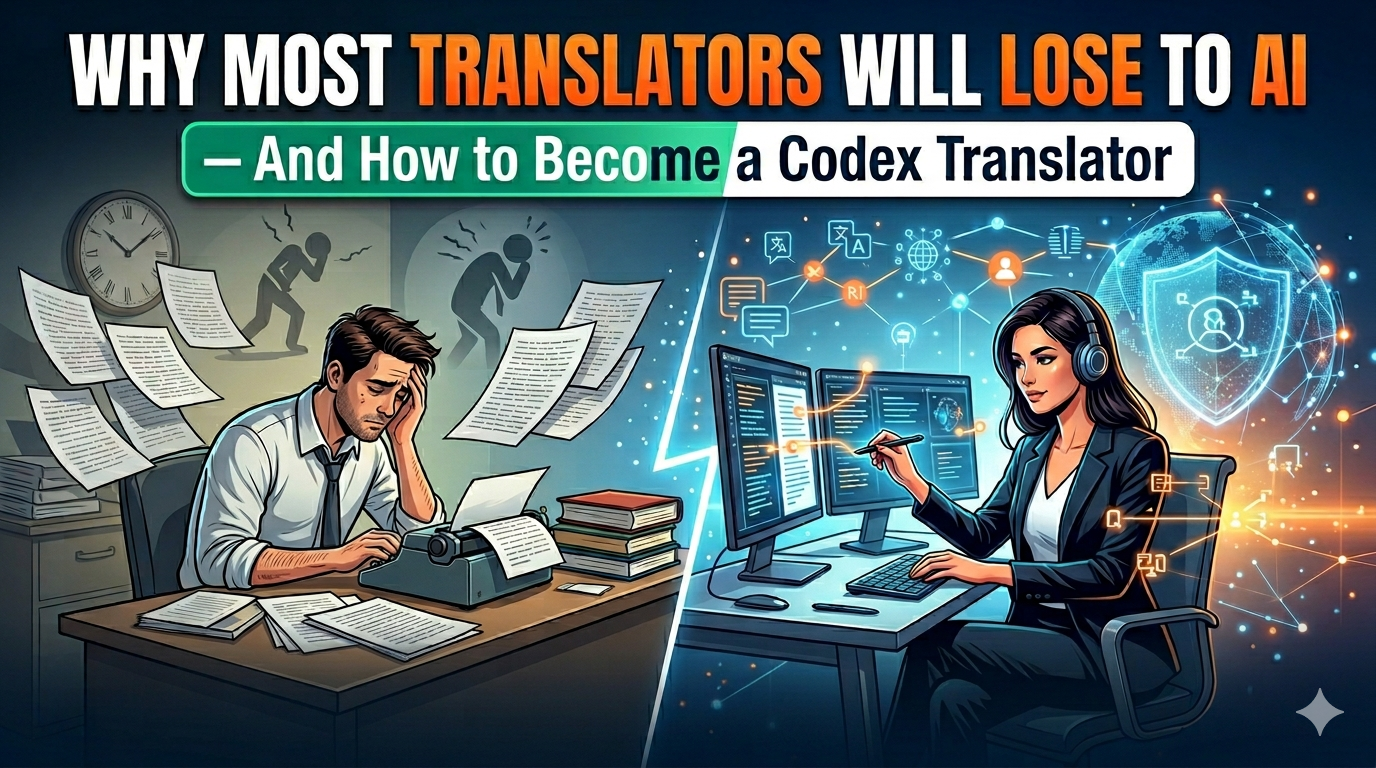
AI is changing translation faster than most people realize.
Many translators believe that improving their English skills will keep them competitive.
But this assumption is already outdated.
The real shift is not about language anymore.
It’s about systems.
In this article, I will explain:
- Why even skilled translators are at risk
- What most people misunderstand about AI
- And how to build a sustainable advantage using a “Codex” approach
The Problem: Translation Without a System
Most translators work like this:
- Read the source text
- Think about the meaning
- Translate sentence by sentence
This works — but only to a point.
The problem is that this process is:
- Not scalable
- Not reusable
- Highly dependent on individual effort
Every new project becomes a fresh start.
In the age of AI, this is a fatal weakness.
Why “Good Translators” Are Actually in Danger
Here’s the uncomfortable truth:
👉 The better you are at doing everything yourself,
👉 the harder it is to adapt to AI.
Why?
Because AI thrives on:
- Patterns
- Repetition
- Structured knowledge
And translation — especially technical and patent translation — is full of patterns.
If you rely only on your skill,
AI will eventually match and surpass your speed.
The Shift: From Skill to System
The future of translation is not:
❌ “Who is the best at translating?”
✅ “Who has the best system?”
This is where the concept of a Codex comes in.
A Codex is:
- A structured knowledge base
- A collection of translation patterns
- A reusable system that grows over time
Instead of translating from scratch,
you reuse, refine, and scale your knowledge.
What Is a Codex Translator?
A Codex Translator does not just translate.
They:
- Build a database of patterns
- Organize knowledge by domain (e.g., semiconductors, batteries)
- Use AI as a multiplier, not a replacement
Over time, their workflow becomes:
- Faster
- More consistent
- More scalable
This is how you move from:
👉 2,000 words/day
to
👉 8,000+ words/day with higher quality
Why This Matters Now
We are entering an era where:
- AI can generate decent translations instantly
- Clients care about speed, consistency, and cost
- Competition is increasing globally
If you don’t build a system,
you will be competing directly with AI.
That’s a losing game.
My Approach
I am building what I call:
👉 Codex Translation Lab
A system where:
- Every translation becomes data
- Every project improves the next
- AI is trained on my structured knowledge
The goal is simple:
👉 Stop working harder
👉 Start building leverage
Conclusion
The future of translation belongs to those who can:
- Think in systems
- Build reusable knowledge
- Integrate AI effectively
Language skill alone is no longer enough.
The real advantage is:
👉 Structure
👉 System
👉 Codex
Call to Action
If you’re interested in:
- AI-powered translation
- Building your own Codex
- Creating a scalable translation workflow
Stay tuned.
This blog will document everything.







コメント