Introduction
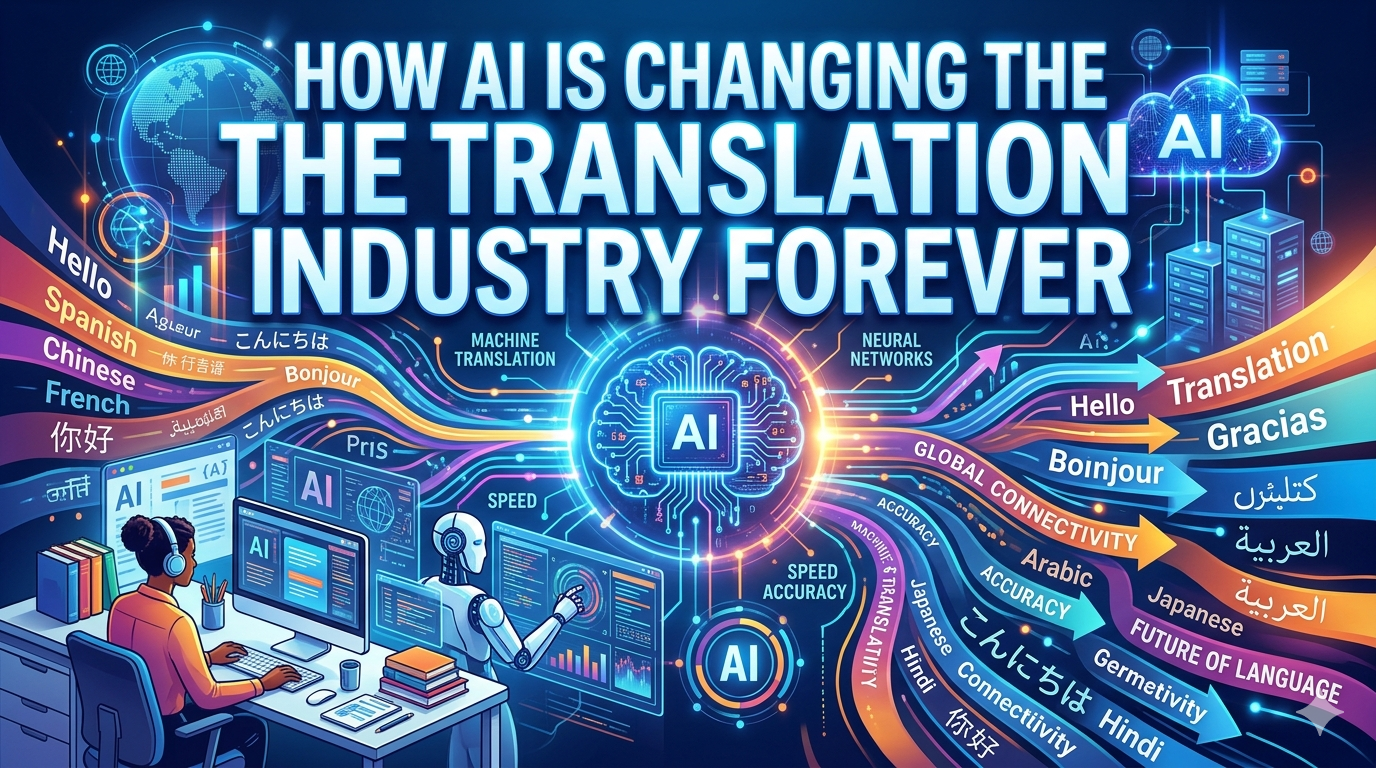
Artificial intelligence is not just improving translation—it is redefining the entire industry.
With powerful tools like ChatGPT, DeepL, and Google Translate becoming standard in professional workflows, the rules of translation have fundamentally changed.
👉 This is not a temporary trend.
👉 This is a permanent shift.
In this article, we’ll explore how AI is transforming the translation industry—and what it means for the future.
1. From Human-Centered to AI-Assisted Workflows
The most significant change is how translation is done.
Before AI:
- Humans translated everything manually
- Time-consuming and labor-intensive
After AI:
- AI generates initial drafts
- Humans review, refine, and validate
👉 The role of the translator has shifted from creator → evaluator.
2. Speed Has Become the New Standard
AI has drastically increased translation speed.
What used to take hours can now be done in minutes.
Impact:
- Faster project turnaround
- Higher client expectations
- Increased workload capacity
👉 Speed is no longer a competitive advantage—it’s a baseline requirement.
3. The Economics of Translation Are Changing
AI is reshaping pricing models.
Old Model:
- Per-word pricing
- Payment based on volume
New Model:
- Value-based pricing
- Payment based on expertise
👉 Translators are moving from labor-based work → knowledge-based work.
4. The Rise of Post-Editing and Quality Control
AI output still requires human oversight.
This has led to the growth of:
- Post-editing
- Quality assurance
- Consistency management
👉 Translation is becoming a multi-step process.
5. Specialization Is More Important Than Ever
AI handles general content well.
But struggles with:
- Technical complexity
- Legal precision
- Domain-specific language
👉 This increases demand for specialists in:
- Patent translation
- Legal translation
- Medical translation
- Financial translation
6. The Emergence of Hybrid Professionals
A new type of professional is emerging:
👉 The AI-Augmented Translator
They:
- Use AI for efficiency
- Apply expertise for accuracy
- Optimize workflows
👉 This hybrid skill set is becoming essential.
7. The Industry Is Polarizing
AI is creating a divide:
🔻 Low-End Market
- Automated
- Low-cost
- Highly competitive
🔺 High-End Market
- Expertise-driven
- High-value
- Less competition
👉 The middle ground is shrinking.
8. The Global Impact
AI is accelerating globalization.
Companies can now:
- Launch products in multiple languages instantly
- Expand into new markets faster
- Communicate at scale
👉 Translation is becoming a core business function, not just a support service.
9. The Role of Human Translators Is Evolving
Human translators are no longer just translators.
They are becoming:
- Editors
- Analysts
- Decision-makers
- Meaning architects
👉 Their value lies in judgment, not just output.
10. Final Insight: This Change Is Permanent
AI is not a passing trend.
It is fundamentally reshaping:
- Workflows
- Skills
- Business models
- Market dynamics
👉 The translation industry will never return to its previous state.
Conclusion
AI is changing the translation industry forever.
But it is not destroying it.
👉 It is transforming it into something more efficient, more specialized, and more valuable.
The future belongs to those who adapt.
👉 The question is not whether AI will change your work.
👉 The question is: How will you change with it?





コメント