Introduction
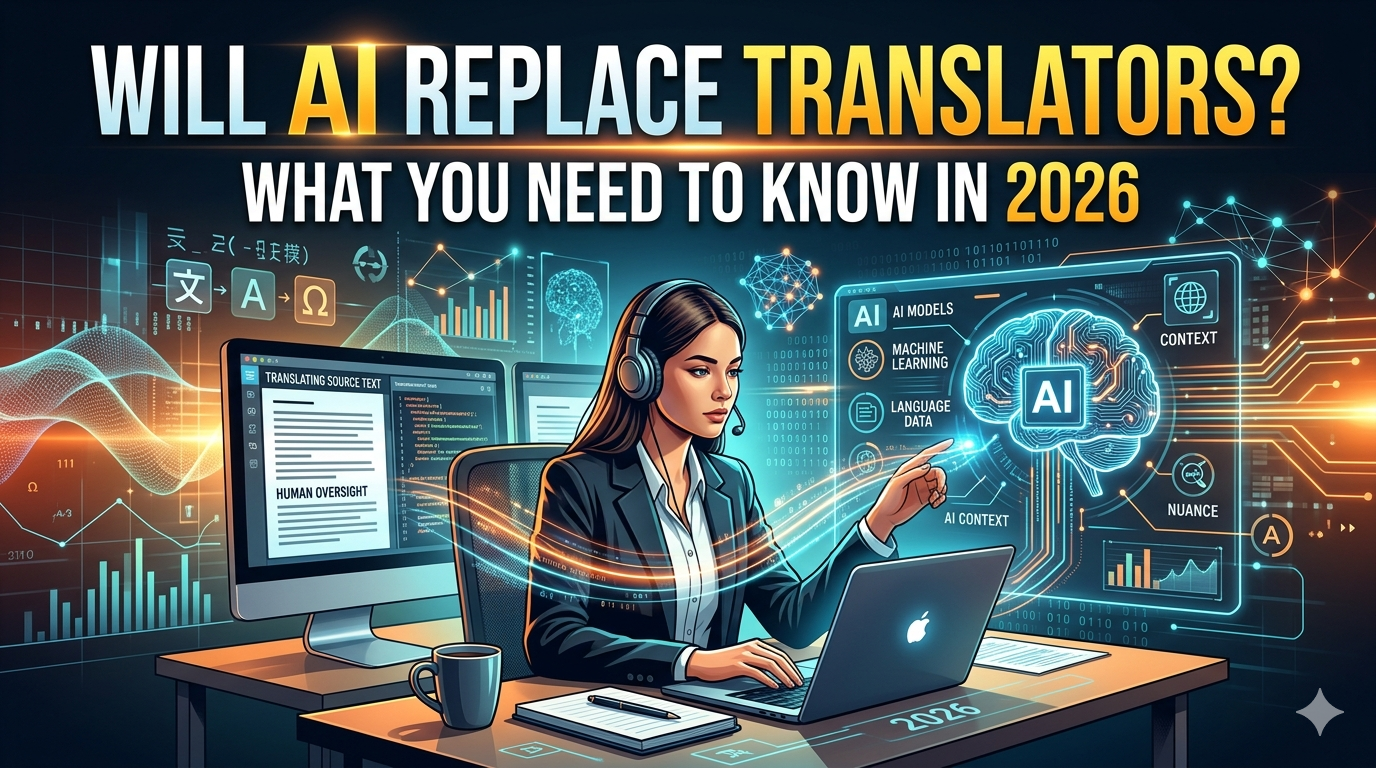
As AI continues to evolve at an unprecedented pace, one question dominates the translation industry:
Will AI replace translators in 2026?
With tools like ChatGPT, DeepL, and Google Translate becoming more powerful each year, many believe that human translators are on the brink of extinction.
But is that really true?
In this article, we’ll break down what is actually happening in 2026, what has changed, and what translators need to do to stay relevant.
1. The State of AI Translation in 2026
AI translation in 2026 is no longer just about replacing words.
It has evolved into:
- Context-aware translation (to some extent)
- Style adaptation
- Domain-specific fine-tuning
- Integration into workflows (CAT tools, APIs, automation)
👉 In short: AI is now a production tool, not just a helper.
However, this does not mean it can fully replace human translators.
2. What AI Has Already Replaced
Let’s be honest—AI has replaced certain types of translation.
✅ Already Replaced (or Mostly Automated)
- Basic content translation
- User-generated content
- Internal communications
- Simple e-commerce descriptions
These areas have become commoditized.
If your work falls entirely into this category, the risk is real.
3. What AI Still Cannot Replace (Even in 2026)
Despite major advancements, AI still struggles with:
❌ Logical Precision
Especially in:
- Patent claims
- Legal clauses
- Financial disclosures
❌ Responsibility and Risk Management
In high-stakes industries, errors can cost millions.
AI cannot take responsibility—humans must.
❌ True Structural Understanding
AI generates text based on patterns, not deep meaning.
👉 This is where expert translators outperform AI.
4. The Biggest Change: Workflow, Not Replacement
The biggest shift in 2026 is not “replacement”—it’s workflow transformation.
Old Model:
Human → Translate everything manually
New Model:
AI → Generate draft
Human → Edit, validate, restructure
👉 Translators are becoming editors, decision-makers, and architects of meaning.
5. The Rise of High-Value Translation Skills
To survive (and win) in 2026, translators must develop:
🔥 1. Domain Expertise
- Patents
- Legal
- Medical
- Finance
🔥 2. Structural Thinking
Understanding relationships, logic, and intent—not just words.
🔥 3. AI Collaboration Skills
- Prompting
- Post-editing
- Workflow optimization
6. The Hidden Truth: AI Increases Demand for Experts
Here’s the paradox:
👉 The easier translation becomes, the more important quality control becomes.
Companies now:
- Produce more multilingual content
- Move faster
- Rely on AI outputs
Which leads to:
👉 More need for expert validation
7. Who Will Be Replaced?
Let’s be clear.
🚫 At Risk:
- Translators who rely only on manual work
- Translators without specialization
- Translators who ignore AI
🚀 Safe (and Thriving):
- AI-augmented translators
- Specialists in high-risk domains
- Those who understand meaning beyond text
8. Final Answer: Will AI Replace Translators?
Partially—but not completely.
👉 AI will replace tasks, not professionals.
The role of translators is evolving, not disappearing.
Conclusion
AI is not your enemy—it’s your leverage.
In 2026, the question is no longer:
“Will AI replace translators?”
But:
👉 “Will you adapt faster than AI evolves?”






コメント