Introduction
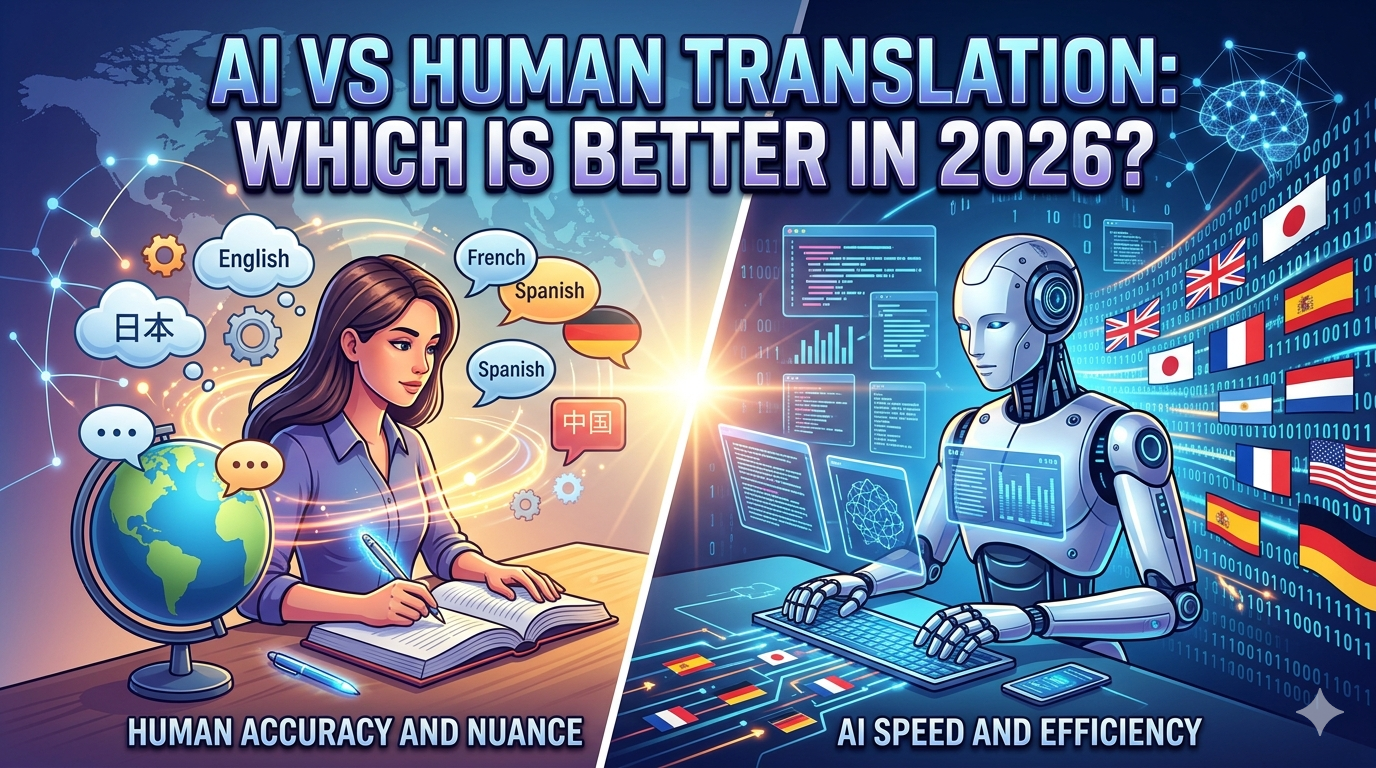
In 2026, translation technology has reached a turning point.
With advanced AI tools like ChatGPT, DeepL, and Google Translate, many are asking:
👉 Is AI translation better than human translation?
The answer is not as simple as “yes” or “no.”
In this article, we’ll compare AI and human translation in 2026, analyze their strengths and weaknesses, and help you understand which is better depending on the situation.
1. The Short Answer
Let’s start with the conclusion:
👉 AI is better for speed and cost.
👉 Humans are better for accuracy and meaning.
The real question is not which is better overall—
👉 It’s which is better for your specific use case.
2. AI Translation: Strengths and Weaknesses
✅ Strengths of AI Translation
① Speed
AI can translate thousands of words in seconds.
② Cost Efficiency
Often free or extremely low-cost.
③ Scalability
Handles large volumes instantly.
❌ Weaknesses of AI Translation
① Lack of Deep Understanding
AI predicts patterns—it does not truly understand meaning.
② Errors in Complex Texts
Struggles with legal, technical, and nuanced content.
③ No Accountability
AI cannot take responsibility for mistakes.
3. Human Translation: Strengths and Weaknesses
✅ Strengths of Human Translation
① Accuracy and Precision
Humans interpret context, logic, and intent.
② Cultural Understanding
Able to adapt tone, nuance, and audience expectations.
③ Responsibility
Humans ensure quality and take accountability.
❌ Weaknesses of Human Translation
① Slower Speed
Manual work takes time.
② Higher Cost
Professional services can be expensive.
③ Limited Scalability
Humans cannot match AI’s processing speed.
4. Side-by-Side Comparison
| Factor | AI Translation | Human Translation |
|---|---|---|
| Speed | Extremely fast | Slower |
| Cost | Very low | Higher |
| Accuracy | Moderate | High |
| Context | Limited | Deep understanding |
| Accountability | None | Full responsibility |
| Scalability | High | Limited |
👉 Each has clear advantages depending on the task.
5. When AI Translation Is Better
AI is the better choice when:
- Speed is critical
- Budget is limited
- Content is simple
- Perfect accuracy is not required
Examples:
- Internal documents
- Blog drafts
- User-generated content
6. When Human Translation Is Better
Human translation is essential when:
- Accuracy is critical
- Legal or financial risk is involved
- Technical precision is required
- Brand voice matters
Examples:
- Patent documents
- Legal contracts
- Medical texts
- Financial reports
7. The Real Winner: Hybrid Translation
In 2026, the best approach is not AI vs human.
👉 It’s AI + human collaboration.
Workflow:
- AI generates a draft
- Human reviews and edits
- Final output is optimized
👉 This combination delivers:
- Speed
- Accuracy
- Scalability
8. The Future Outlook
The debate will continue, but the trend is clear:
👉 AI will dominate low-value tasks
👉 Humans will dominate high-value work
The role of translators is shifting from:
- Translators → Editors
- Translators → Decision-makers
- Translators → Meaning architects
Final Verdict
So, which is better in 2026?
👉 Neither—on their own.
👉 Together, they are unbeatable.
Conclusion
AI has changed the translation industry forever.
But it has not replaced human translators.
Instead, it has redefined their role.
👉 The future belongs to those who can combine human intelligence with AI power.





コメント