Introduction
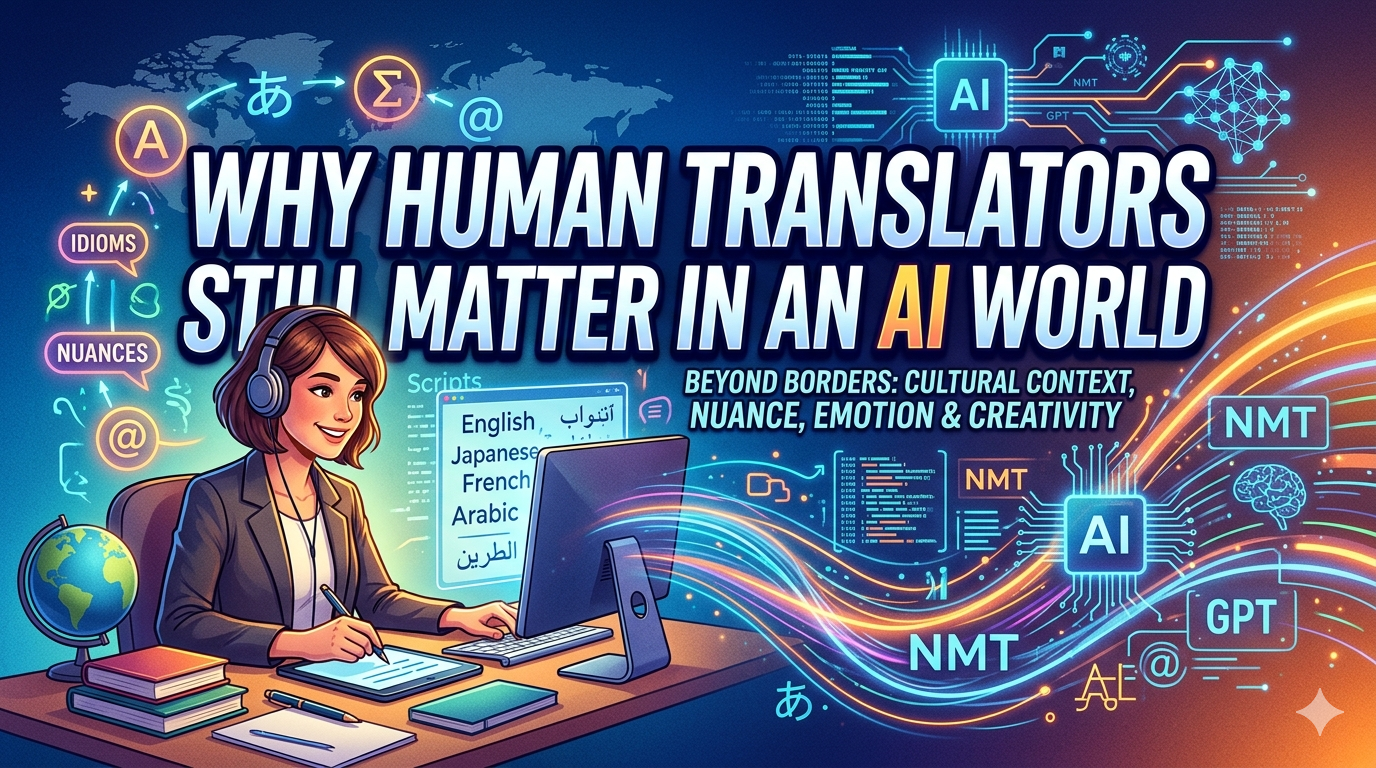
Artificial intelligence has transformed the way we translate.
With tools like ChatGPT, DeepL, and Google Translate delivering instant results, many assume that human translators are becoming obsolete.
But here’s the truth:
👉 Human translators matter more than ever.
In this article, we’ll explore why human expertise remains essential in an AI-driven world—and what makes it irreplaceable.
1. Translation Is More Than Words
AI translates words.
Humans translate meaning.
This distinction is critical.
Language is not just vocabulary—it is:
- Context
- Intent
- Logic
- Culture
AI can generate fluent sentences, but it does not truly understand meaning.
👉 Human translators interpret what the text is trying to do, not just what it says.
2. Accuracy Is Not Optional in High-Stakes Fields
In many industries, translation errors are not just inconvenient—they are dangerous.
High-Risk Domains:
- Legal contracts
- Patent claims
- Medical documents
- Financial reports
A single mistake can lead to:
- Legal disputes
- Financial losses
- Safety risks
👉 AI cannot take responsibility.
👉 Humans can.
This alone ensures the continued importance of human translators.
3. Context and Nuance Still Require Humans
AI struggles with:
❌ Ambiguity
❌ Cultural nuance
❌ Implicit meaning
For example:
- Sarcasm
- Idioms
- Industry-specific phrasing
These require interpretation, not pattern prediction.
👉 Human translators bring judgment, not just output.
4. The Role of Human Translators Is Evolving
Human translators are not disappearing—they are evolving.
Old Role:
- Translate text manually
New Role:
- Validate AI output
- Refine meaning
- Ensure consistency
- Make critical decisions
👉 Translators are becoming language experts and decision-makers.
5. Human + AI = The Winning Combination
The future is not human vs AI.
It is:
👉 Human + AI
AI provides:
- Speed
- Efficiency
- Draft generation
Humans provide:
- Accuracy
- Context
- Responsibility
👉 Together, they create the best results.
6. Trust Is Built by Humans, Not Machines
Clients don’t just want translations.
They want:
- Reliability
- Accountability
- Expertise
AI cannot build trust.
👉 Trust is a human function.
This is why businesses continue to rely on human professionals.
7. The Real Value: Structural Understanding
Here’s the deeper insight.
Great translation is about understanding structure:
- Logical relationships
- Cause and effect
- Technical frameworks
AI often misses these layers.
👉 Human translators reconstruct meaning at a deeper level.
This is what separates professionals from automated systems.
8. Final Thought: Human Translators Are Not Replaceable
AI will continue to improve.
But:
👉 It will not replace human judgment, responsibility, and deep understanding.
Human translators are not becoming irrelevant.
👉 They are becoming more specialized and more valuable.
Conclusion
In an AI-driven world, the role of human translators is clearer than ever.
They are not just translators.
👉 They are interpreters of meaning.
👉 Guardians of accuracy.
👉 Architects of communication.
AI changes the tools—but not the need for human expertise.




コメント